The Great AI Stress Test: Why India Must Trade Rote Skills for Radical Imagination
India faces a defining AI stress test. With 8 million jobs needed annually, AI is reshaping work, education, and healthcare. The shift from subskills to macro-thinking demands urgent institutional reform, digital access equity, and lifelong learning to secure India’s demographic dividend.
The atmosphere at the AI Impact Summit 2026 was defined by what can only be described as "creative chaos." It is the kind of friction that occurs when a demographic titan meets a technological disruptor. As the Chief Economic Adviser, V. Anantha Nageswaran, observed during the proceedings, we are no longer debating a hypothetical future. We are undergoing a "stress test" of our state capacity and social cohesion.
The stakes are quantified by a relentless ticking clock: the Economic Survey 2024 dictates that India must create 8 million jobs annually to harness its demographic window. This is not merely a policy goal; it is an existential requirement. If we fail to align our institutional reform with technological adoption, we risk transforming our greatest asset—our youth—into a structural vulnerability.
The Great Institutional Mismatch: A Crisis of Access
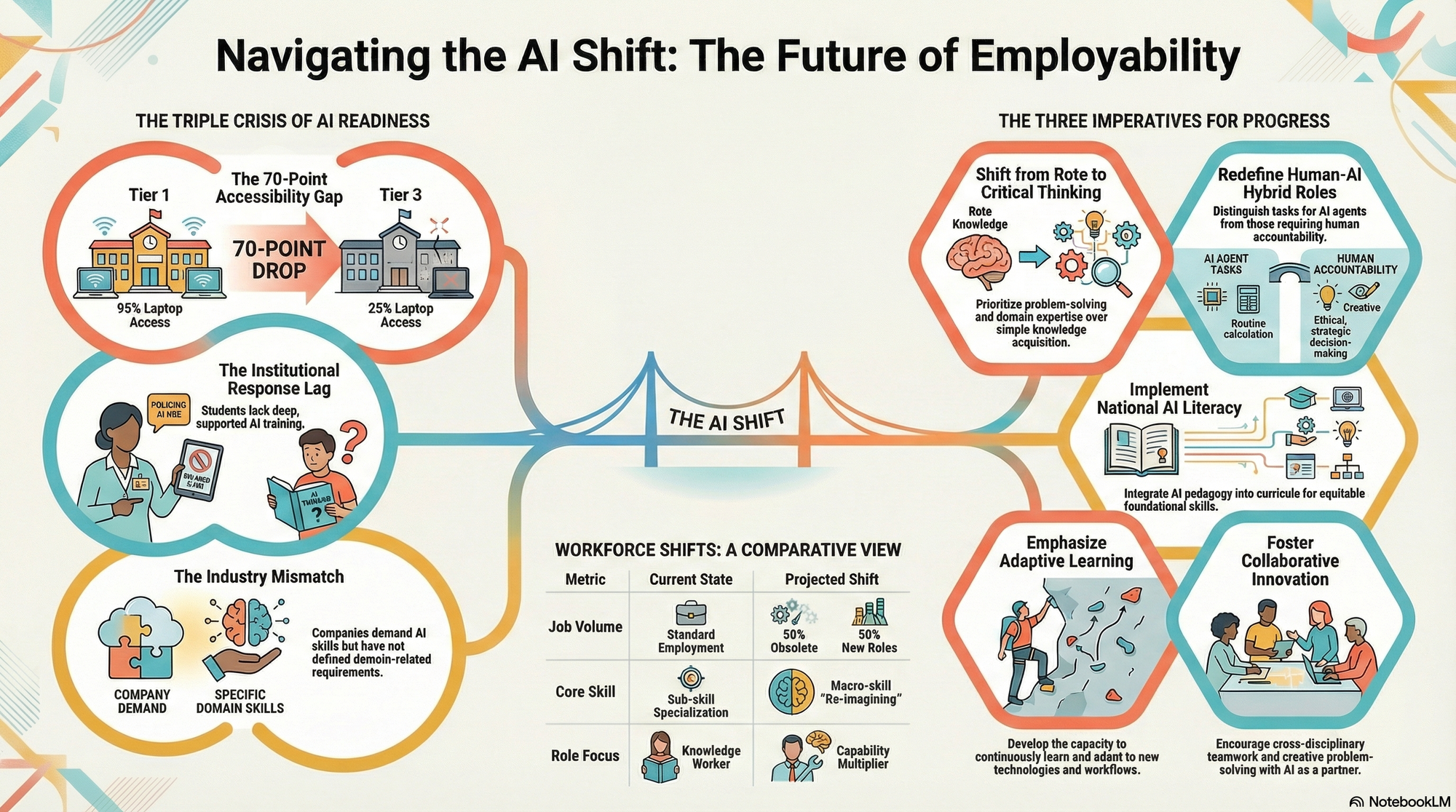
The first crack in the stress test is the profound disconnect between the base of our workforce and the institutions meant to shepherd them. There is a "surreptitious" revolution occurring in our classrooms. While educational bodies remain paralyzed by pedagogical inertia—focusing on "policing" AI and imposing restrictions—students are already using these tools extensively.
However, because this adoption happens in the shadows without institutional guidance, it remains superficial. Students are using AI to bypass the labor of learning rather than to deepen it. This mismatch is further poisoned by a staggering accessibility gap that threatens to bake inequality into the very foundations of our digital future.
"In tier 1 institutions, 95% of students have access to a laptop, but in tier 3 it drops to 25%—a striking 70-point disparity in accessibility."
This disparity, compounded by the fact that high-end AI models are often locked behind dollar-denominated paywalls, creates a tiered workforce. If we do not address this, we are not just failing to skill our youth; we are creating a digital caste system where the "demographic dividend" quickly sours into a demographic liability.
The Death of the Subskill and the Rise of the "Re-imagineer"
For a century, the Industrial Age operated on a logic of "dummification." We broke complex processes into tiny subskills, training millions of knowledge workers to perform micro-tasks with rote efficiency. As Vinit Nayar, founder of the Sampark Foundation, notes, AI has officially killed the value of the subskill. Automation now handles the "how" faster, cheaper, and better than any human.
The new era demands the "Re-imagineer"—a worker capable of "Macro Skills." This isn't about knowing algebra; it’s about the ability to solve problems that have no existing template. Nayar points to a brilliant pedagogical shift at the Sampark Foundation: they use "half stories" to teach children. By providing the beginning of a narrative and asking the child to imagine the end, they are cultivating "jugaad thinking"—that quintessentially Indian trait of lateral, imaginative problem-solving. In a world of automated answers, the person who can ask the right question and imagine a new solution becomes the most valuable asset in the room.
The "3 Humans, 5 Agents" Office
From the perspective of enterprise IT, the office is not being emptied; it is being restructured. Satish Sitha Rama, CEO of Edge, views AI as a "capability multiplier" that will eventually see the traditional eight-person "scrum" team evolve into a hybrid of three humans and five AI agents.
In this model, the human role shifts from execution to accountability and problem definition. This "atomization" of personality and role is already visible in media. As Smita Prakash observes, AI could soon offer personalized versions of news anchors—perhaps a "milder" version of Arnab Goswami for your 8:00 PM wind-down and a more "excitable" version for 9:00 PM. The human's value lies in managing these agents and taking ultimate responsibility for the outcome.
"AI should be seen as a capability multiplier in the hands of every worker, not merely a tool for replacement."
The "Don't Panic" History Lesson: 1982 vs. 2026
History offers a soothing, if cautionary, parallel. Sanjeev Bikhchandani of Info Edge recalls the introduction of PCs in the early 1980s. When computers first entered Indian banks in 1985, trade unions predicted the end of employment. Instead, productivity skyrocketed, and not a single job was lost.
The lesson, however, is about who wins the transition. Bikhchandani notes that the 1988 and 1989 batches of the Indian Institutes of Management (IIM) were the first to have actual PC access. While their seniors were still hand-writing transparencies, these graduates were using "Harvard Graphics" to create professional presentations. They weren't computer scientists; they were simply the first to master a tool that was "easy to use but never taught." The mandate for today’s worker is equally blunt: "If you don't do AI, AI will be done to you."
Healthcare’s Great Leapfrog: Beyond "Sick-Care"
Perhaps the most optimistic facet of the stress test is the potential for India to "leapfrog" global standards in healthcare. By moving away from the Western "sick-centric" model—where care is trapped within expensive hospital walls—India can use AI to move care into the community.
This shift could create 150 million new jobs within the Indian healthcare ecosystem. We are talking about entirely new roles, such as "care navigators for high-risk cohorts," who use AI-enabled diagnostics to manage chronic conditions like diabetes at the village level. By bypassing the legacy infrastructure of the West, India can build an AI-augmented, community-based health system from the ground up.
The 50/50 Rule and the Battle for Sovereignty
Despite the potential for growth, we must confront a stark reality: 50% of current jobs will vanish. The roles that rely on rote subskills are effectively obsolete. While 50% more jobs will likely be created, the battle for who owns those jobs is being fought on the terrain of "digital colonialism."
Smita Prakash warns that Big Tech giants are currently scraping Indian media content without paying for Intellectual Property Rights (IPR), even as they pay millions to Western outlets. This is a repeat of the "Microsoft DOS" cautionary tale: decades ago, Indian firms like HCL and TCS had their own operating systems. However, when DOS was "thrown free" and allowed to be pirated, it killed domestic innovation, leading to a decades-long "subscription dependency." Today, if India loses the race for Large Language Models (LLMs) and data sovereignty, we risk becoming a mere consumer of technologies trained on our own data.
"This fight is not about India; it is being fought in the international space to determine who will use technology to create jobs and get a major share."
Conclusion: The Lifelong Learnability Mandate
The era of "learn once, work forever" has been replaced by the "Lifelong Learnability" mandate. The speed of change is no longer linear; it is accelerating. The distinction between "up-skilling" (improving at your old job) and "re-skilling" (preparing for a job that doesn't yet exist) is now the line between success and obsolescence.
The AI stress test asks us if we can pivot from being "knowledge workers" to "accountability holders." It asks if our institutions can stop policing tools and start fostering imagination.
A final thought: In a world where the technical "subskill" is now a commodity provided for free by a machine, what is your unique human signature worth? And more importantly—to ensure you are the one "doing AI" rather than being "done to by AI"—which three platforms will you commit to mastering in the next 90 days?